Businesses are automating confusion.
Over the last few months, work inside AI systems has exposed a recurring issue: implementations underperform when they’re layered onto workflows that were never properly structured in the first place.
This work has involved training systems, evaluating outputs, identifying where interpretation breaks down, and improving how AI generates responses across text, image, audio, video, and multimodal environments.
Writing prompts. Evaluating outputs. Identifying where systems interpret information incorrectly. Improving how AI generates responses across different formats and operational contexts.
And what becomes clear quickly is this: AI implementations struggle because they’re often being introduced into workflows that already lack operational clarity.
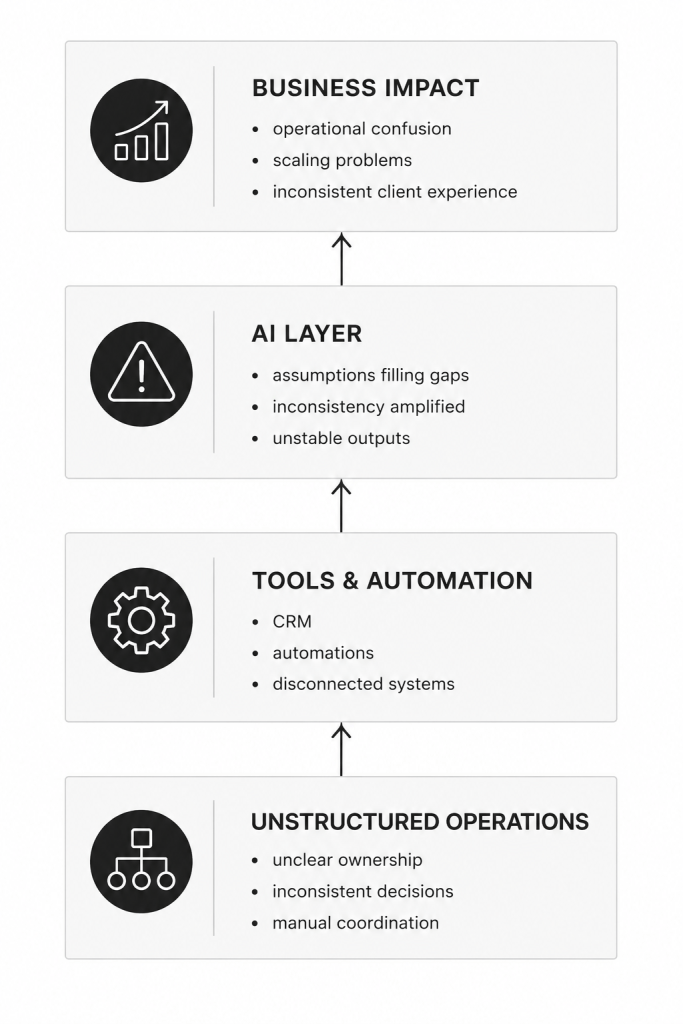
Adding AI to unstructured operations amplifies inconsistency instead of reducing it.
The Issue Underneath
Operational clarity is where most AI implementations begin to fail.
Businesses apply AI to workflows where ownership is unclear, decisions haven’t been mapped, and follow-ups still depend on memory and manual coordination.
Automation follows rules. AI works through context.
If the rules are unclear, automation breaks. If the context is inconsistent, AI starts filling gaps with assumptions.
The result is inconsistency at scale.
What This Looks Like in Practice
AI training work exposes something most businesses miss: quality cannot improve without clear standards.
In image-based AI training, recreation requires precision because everything must be described properly — size, colour, texture, shadows, reflections, positioning, spacing.
Evaluation also requires clear criteria: instruction following, accuracy, completeness, and consistency.
Without that, outputs can’t be judged properly. And if outputs can’t be evaluated consistently, they can’t be improved consistently either.
Most businesses don’t have clear operational standards for what “good” actually looks like. Lead handling varies. Follow-ups are inconsistent. Processes are loosely defined or undocumented.
Then AI gets introduced, but there’s nothing stable underneath to evaluate against. So nothing meaningfully improves, because the underlying operational structure is still the issue.
Where This Shows Up in Business Operations
The same thing happens operationally inside businesses.
A large part of AI audio evaluation work involves assessing instruction-following, pronunciation, pacing, tone similarity, contextual accuracy, audio quality, and whether outputs remain stable under changing inputs.
When communication, workflow movement, and decision-making are inconsistent, AI systems don’t reduce pressure. They expose it faster and amplify it at scale.
This shows up quickly in areas like AI voice agents, lead follow-up systems, appointment handling, and customer communication workflows.
If the operational structure underneath is inconsistent, the output becomes inconsistent too because the workflow itself was never stable to begin with.
The Operational Clarity Problem
Most businesses are struggling with how their operations are structured underneath.
Adding AI to unclear workflows and messy data just layers automation on top of chaos. The real leverage comes from getting the operational foundations right first so everything built on top can actually function properly.
Operational systems need to exist before AI systems or tools can operate effectively.
Before introducing AI, the workflow itself needs to be visible.
That means understanding how work actually moves through a business. Not how it is assumed to move, but how it actually behaves when a lead comes in, when a client onboards, when a project transitions between stages, and when decisions need to be made without founder involvement.
Most service-based businesses still operate through founder memory. The founder knows what needs to happen next because they’ve repeated the process enough times internally. But that operational knowledge often isn’t documented, systemised, or transferable.
So when AI gets introduced, it cannot access the context that still exists only inside someone’s head. It cannot operate using judgement that was never clearly articulated into the workflow itself.
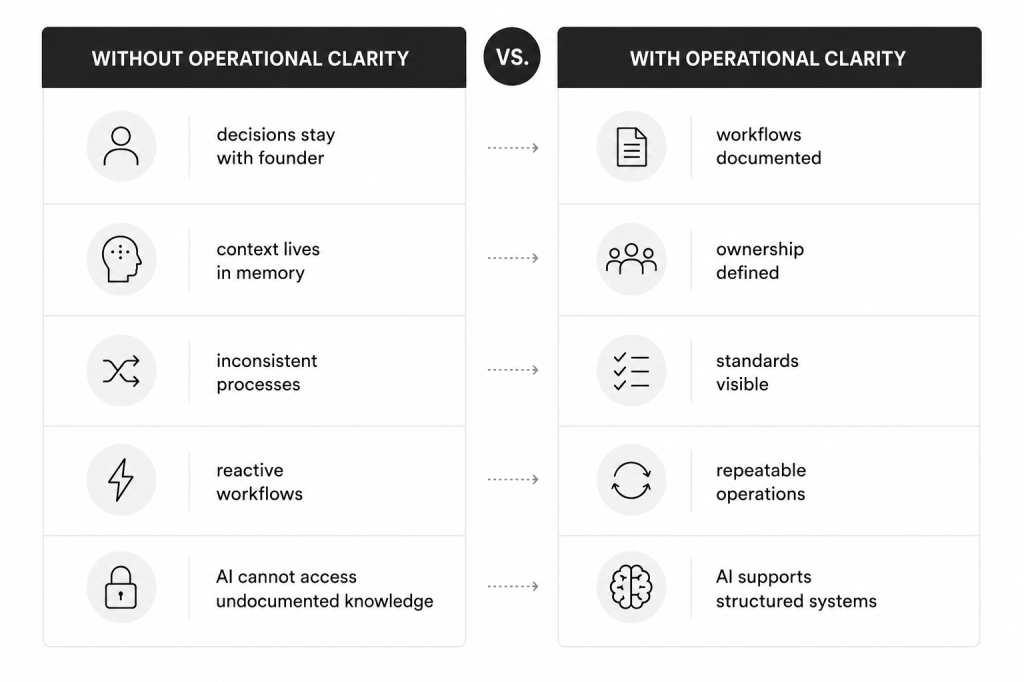
Operational clarity makes workflows transferable, repeatable, and AI-ready.
What This Means for Service-Based Businesses
Service-based businesses face a specific challenge with AI adoption.
Unlike product businesses with repeatable manufacturing processes or e-commerce businesses with standardised transactions, service businesses operate through relationships, custom deliverables, and founder judgement.
The work is less standardised by nature. Each client is different. Each project carries nuances. Each decision requires context.
This makes AI adoption harder. But it also makes operational clarity significantly more valuable.
Once a service business properly structures how operations actually function—how decisions are made, how work moves between stages, and how quality is maintained without constant founder involvement—AI can support that structure instead of fighting against it.
The businesses that will successfully adopt AI are not the ones rushing to implement every new tool. They are the ones building operational foundations that make AI implementation possible.
The Path Forward
Before introducing AI, the workflow itself needs to be visible.
Otherwise, the system isn’t being improved. The confusion already inside the business is simply being accelerated.
The work isn’t about finding better AI tools. The work is about building operational infrastructure that makes AI useful.
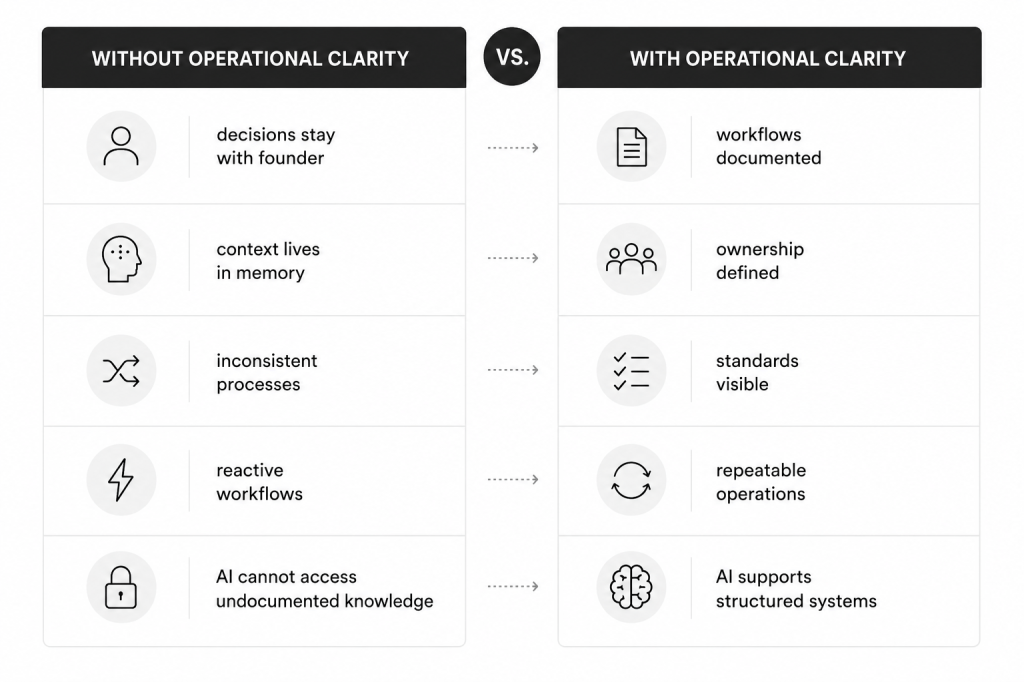
AI performs best when operational structure exists underneath it.
If a business still depends on the founder to keep things moving—where decisions sit with one person, follow-ups rely on memory, and work gets handled differently depending on the situation—the issue usually isn’t the tools.
The issue is the operational structure underneath.
ScaleDPS has put together a free guide that breaks down where operational pressure actually builds: where work slows down instead of compounding, where decisions stop instead of moving, and where the business still relies too heavily on founder involvement to function consistently.
 ScaleDPS
Leave a comment